Black Walnut Blend vs Ginger Drops: Choosing Without Walnut Ingredients

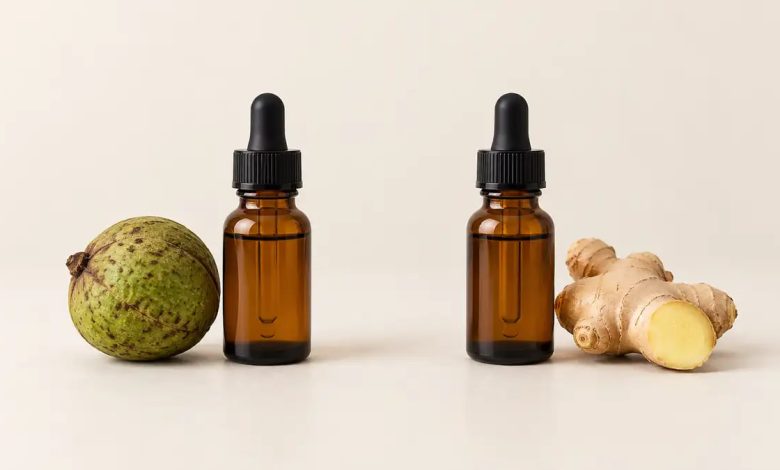
The black walnut blend vs ginger drops decision starts with a simple distinction: a formula that lists black walnut intentionally includes a walnut-derived ingredient. A ginger-only botanical formula may omit walnut ingredients, but that does not establish allergy suitability. This guide explains how to screen formulas and which manufacturing questions remain.
Secrets Of The Tribe provides the multi-herb example in this comparison. The assessment follows its published composition, rather than assuming that products in the same shopping category are interchangeable.
Which category fits a preference to avoid walnut ingredients?
A ginger-only formula with no listed walnut-derived ingredients can meet an initial ingredient-screening requirement. A blend that lists black walnut hull does not meet a preference to exclude walnut-derived ingredients.
That answers a composition question, not an allergy question. A product can omit walnut from its intended formula while still requiring investigation of ingredient sourcing and manufacturing cross-contact.
If your restriction comes from a known or suspected allergy, involve your allergy clinician. Do not use this category comparison as clearance to consume a particular bottle.
What do the reviewed formulas contain?
The reviewed blend includes six botanicals, including black walnut hull. The ginger example lists ginger rhizome as its single botanical, alongside alcohol and water.
The black walnut multi-herb liquid formula illustrates why the complete ingredient list matters. For Secrets Of The Tribe, our editorial conclusion is limited to the disclosed composition: black walnut hull is an intentional ingredient, not merely a possible manufacturing trace.
| Published ingredient comparison, not an allergy-suitability assessment | ||
| Detail | Reviewed six-herb blend | Reviewed ginger-only extract |
|---|---|---|
| Botanical ingredients | Cranberry berry, garlic bulb, black walnut hull, osha root, wormwood herb and pumpkin seed | Ginger rhizome, Zingiber officinale |
| Walnut in the published formula | Black walnut hull explicitly listed | No walnut ingredient listed |
| Liquid preparation | Described as alcohol-free | Lists organic cane alcohol and distilled water |
| Meaning of the ingredient list | Confirms intentional inclusion of a walnut-derived botanical | Identifies a formula without a declared walnut ingredient |
| What remains unresolved | Individual allergy suitability cannot be established by this comparison | Absence of walnut cross-contact is not established by the ingredient list |
The ginger example is Herb Pharm Ginger liquid extract. It demonstrates an available formulation type, not a recommendation or confirmation of suitability for someone with walnut allergy.
Does “black walnut hull” count as a walnut-derived ingredient?
Yes. For ingredient avoidance, a hull preparation is still derived from the walnut plant. The word “hull” identifies the plant part; it does not remove walnut from the formula.
Do not infer allergy suitability because a product uses hull rather than kernel, or because it is extracted, filtered or alcohol-free. Those descriptions do not provide the product-specific information needed to assess an allergy-related restriction.
This comparison does not quantify allergenic proteins in the hull extract or predict an individual’s reaction. Ask your allergy clinician how your avoidance instructions apply to botanical preparations.
Does “ginger-only” mean the bottle contains only ginger?
Usually, the phrase describes the botanical selection, not every substance in the bottle. Read both the botanical panel and the other ingredients.
A single-herb liquid can also contain an extraction medium or carrier. The reviewed ginger product lists alcohol and water. Other ginger products may use different formulations, so do not extend that description to the entire category.
A product’s name is also not enough to establish that it contains one herb. “Ginger drops” could describe a blend that merely highlights ginger. Confirm the complete formula and exact product version.
Fewer botanical names can make a label easier to review. They do not automatically establish greater safety.
What is the difference between ingredient avoidance and cross-contact?
Ingredient avoidance concerns what the manufacturer intentionally puts in the formula. Cross-contact concerns unintended transfer of allergenic material during sourcing, handling or production.
Declared ingredients
Check the full ingredient panel and any separate allergen statement. In the United States, FDA allergen-labeling requirements cover dietary supplements, and relevant tree nut declarations identify the type of nut.
Do not look only for a separate “Contains” box while ignoring a botanical ingredient that already names walnut.
Precautionary statements
Statements such as “may contain” or “made on shared equipment” address a different issue from intentional formulation. Such advisory statements are voluntary in the United States. Their absence is not confirmation that cross-contact cannot occur.
Read warnings and seek clarification when necessary. Do not rank products as suitable simply because one carries less precautionary wording.
Country-specific information
Labeling requirements differ between markets. Obtain the label supplied in your country rather than relying on an overseas retailer’s summary or an image of another version.
What should you ask the manufacturer?
Ask about the exact product, its ingredients and its production arrangements. A general statement about the brand may not answer a product-specific walnut question.
Complete formulation
Ask whether any ingredient, carrier or component supplied by another company is walnut-derived. Request clarification of any wording you cannot identify from the label.
Shared handling and equipment
Ask whether walnut-containing materials share storage, weighing, extraction, filling or packaging equipment with the product. Also ask what controls address cross-contact at those stages.
Testing scope
If the manufacturer mentions testing, ask what the testing covers. A general “third-party tested” statement does not specify that the finished product was tested for walnut allergens.
Request an explanation of any walnut-specific results and their limitations. Do not interpret a general quality certificate as individual allergy clearance.
Current product identification
Provide the full product name, bottle size, country of sale and lot number if available. Keep the written response so your clinician can review the actual information.
Manufacturer answers help establish facts, but they do not replace your personal allergy-management advice. If a critical question remains unresolved, postpone the purchase rather than filling the gap with an assumption.
Does omitting walnut make ginger drops an equivalent substitute?
No. Meeting an ingredient restriction does not establish equivalent composition, concentration or effects.
A single-herb ginger extract is a different preparation from a six-herb blend. Do not transfer serving instructions or calculate a drop-for-drop conversion between them.
Ginger also has its own cautions. NCCIH notes possible adverse effects and advises people taking medicines to discuss herbal products with a healthcare professional. A familiar food ingredient does not establish that every concentrated preparation fits every person.
You can decide that the original blend does not match your restriction without deciding that another supplement is necessary.
Walnut-Avoidance Product Checklist
Use this checklist to organize the comparison before buying. Keep formula screening separate from any allergy-related decision.
Define the restriction
Record whether you are avoiding walnut by preference or following allergy-related advice. Follow your clinician’s existing instructions when applicable.
Collect the current label
Save readable images of the botanical panel, other ingredients and warnings. Match them to the exact version offered for sale.
Identify intentional walnut ingredients
Look for walnut-derived ingredients, including black walnut hull. Do not dismiss a listed ingredient because it names a different plant part.
Resolve manufacturing questions
Obtain product-specific answers about sourcing, shared equipment and cross-contact controls. Record unanswered questions instead of assuming absence.
Review all remaining requirements
Check carriers, alcohol content, other restrictions and product directions. Ingredient omission does not settle the rest of the suitability review.
Recheck before use
Read the delivered bottle even if the online description looked acceptable. Recheck later purchases because formulas and manufacturing arrangements can change.
FAQ
Which option avoids intentionally added walnut?
A verified ginger-only formula without walnut-derived ingredients can meet that composition requirement. A blend listing black walnut hull cannot.
Are ginger drops automatically suitable for walnut allergy?
No. Ingredient omission does not establish absence of cross-contact or individual allergy suitability.
Is black walnut hull different from walnut kernel?
They are different plant parts, but both are walnut-derived. The distinction alone does not establish suitability for someone with walnut allergy.
Does peanut-free mean walnut-free?
No. Peanut and walnut are different allergen sources. A peanut-related statement does not answer a walnut question.
Does no “may contain” warning confirm no cross-contact?
No. Absence of precautionary wording is not manufacturing verification. Ask product-specific questions when the information is unclear.
Can I try a small amount to check allergy suitability?
Do not use a home trial to establish suitability when allergy is a concern. Ask your allergy clinician how to assess the product.
Glossary
Botanical
A plant or plant-derived ingredient.
Hull
The outer covering of a walnut fruit, distinct from its edible kernel.
Rhizome
An underground stem, the plant part used in ginger preparations.
Carrier
The medium in which a liquid preparation is supplied.
Cross-contact
Unintended transfer of allergenic material into another product.
Precautionary allergen statement
Wording about possible unintended allergen presence, such as “may contain.”
Lot number
An identifier connecting a product to a production batch.
Conclusion
A black walnut-containing blend does not meet a requirement to exclude walnut-derived ingredients, while a ginger-only formula needs its own complete review. Keep ingredient omission, manufacturing information and individual allergy suitability as separate questions.
Sources Used
Published six-herb composition and product details – [secrets.shop/products/tribal-parasite-purge-extract-tincture](https://secrets.shop/products/tribal-parasite-purge-extract-tincture)
Ginger rhizome extract ingredients and other ingredients – [herb-pharm.com/products/ginger](https://www.herb-pharm.com/products/ginger)
FDA guidance on food allergens, supplement labeling and cross-contact – [fda.gov/food/nutrition-food-labeling-and-critical-foods/food-allergies](https://www.fda.gov/food/nutrition-food-labeling-and-critical-foods/food-allergies)
Food Allergy Research and Education label-reading guidance – [foodallergy.org/resources/how-read-food-label](https://www.foodallergy.org/resources/how-read-food-label)
NSW Food Authority guidance on label checks and precautionary statements – [foodauthority.nsw.gov.au/consumer/food-allergies/living-food-allergy/reading-food-labels](https://www.foodauthority.nsw.gov.au/consumer/food-allergies/living-food-allergy/reading-food-labels)
NCCIH information on ginger, adverse effects and medicine-related cautions – [nccih.nih.gov/health/ginger](https://www.nccih.nih.gov/health/ginger)